
Bourstad stock market simulations - Summary of
the markets for the week ended on August 8, 2025
Stocks and cryptocurrencies rise, US dollar falls
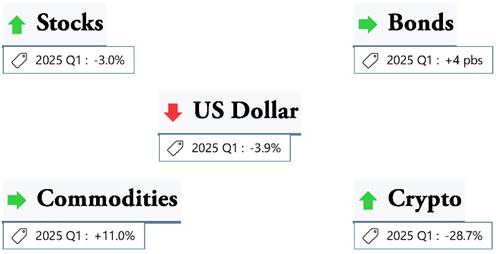
Stocks and cryptocurrencies rose this week, while the US dollar fell.
Bonds and commodities moved without any clear direction. In Canada, employment
declined in July, with -41,000 jobs lost, but the unemployment rate remained
unchanged due to a decline in the labour force participation rate. Statistics
Canada also released international merchandise trade data for June, which
showed a current trade deficit of -$5.9 billion in June 2025. The US trade
deficit in June fell from -US$71.7 billion to -US$60.2 billion in June 2025,
its lowest level in 21 months. The Institute for Supply Management (ISM)
Services PMI fell from 50.8 in June to 50.1 in July, a decline of -0.7. The
threshold of 50 is the dividing line between expansion, i.e., an index above
50, and recession. Elsewhere in the world, the Bank of England lowered its key
interest rate by 25 basis points to 4.0%. This week, we will be monitoring: in
Canada, building permits for June (Tuesday), manufacturing sales for June and
existing home sales for July (Friday); in the US, inflation for July (Tuesday),
the industrial price index for July (Thursday) and retail sales for July
(Friday). Elsewhere in the world, we will also be watching: Japan's gross
domestic product for the second quarter of 2025 and several data releases for
July in China, including retail sales and the unemployment rate.
The six stock markets we track were up this week. The NASDAQ 100 jumped
3.7% over the week. It was followed by the Toronto Stock Exchange, which rose
2.7%, and the Paris Stock Exchange, which advanced 2.6%. The Tokyo and New York
stock exchanges were up 2.5% and 2.4%, respectively. The Shanghai Stock
Exchange closed the week with a 2.1% gain.
Yields on 10-year government bonds are up for two of the four highly
rated countries we track, while Canada's bond yield remains unchanged. A rise
in yield means that the price of a bond is falling, given the inverse
relationship between bond yields and prices. The US bond yield, the main
benchmark rate in the market, rose by 6 bps to 4.29% (1 basis point or bps =
0.01%). The Canadian bond yield was unchanged, giving the Canadian yield a 93
bps spread under the US yield. The yield on German bonds rose by 1 bps to
2.69%. The yield on Japanese bonds fell by 6 bps to 1.49%.
In the commodities market, two of the four commodities we track are up.
The metals in our universe are up 1.0% for gold and 0.8% for copper. The
commodities that have the most influence on inflation are down, with corn
falling -1.7% and US oil (WTI) -5.1%.
In the cryptocurrency sector, the two cryptos we track are up: Bitcoin
is up 2.9% and Ethereum is up 14.6%.
As of August 8, it
costs 0.3¢ CAD less than on August 1 to buy a US dollar. The euro and the yen
are moving in opposite directions to the US dollar, with the single European
currency up 0.5% and the Japanese currency down -0.2%.
See the detailed table by following this link:
https://iclf.ca/DL/BTTT_sommaire_marches_250808.pdf
Paul Bourget
Project Director, Bourstad
CIRANO
paul.bourget@cirano.qc.ca
About CIRANO (www.cirano.qc.ca )
The Center for
Interuniversity Research and Analysis of Organizations (CIRANO) is a
multidisciplinary, liaison and transfer research center, whose mission is to
accelerate the transfer of knowledge between the research community and users
in industry and public services.
About BOURSTAD (www.bourstad.ca )
The Bourstad program
is an activity of the Center for Interuniversity Research and Analysis of
Organizations (CIRANO) which receives support from many partners for this
financial education project: the Autorité des marchés financiers, its main partner,
TD Bank, CFA Montreal , the Canadian Investment
Regulatory Organization (CIRO), Finance Montreal, TMX Group, Hyprasoft, Groupe Investissement responsable and
QuoteMedia.